Know Your Vision
Progressive vs Bifocal vs Single Vision: What’s the Difference?
Lensmaster Knowledge Centre • 5 October 2026
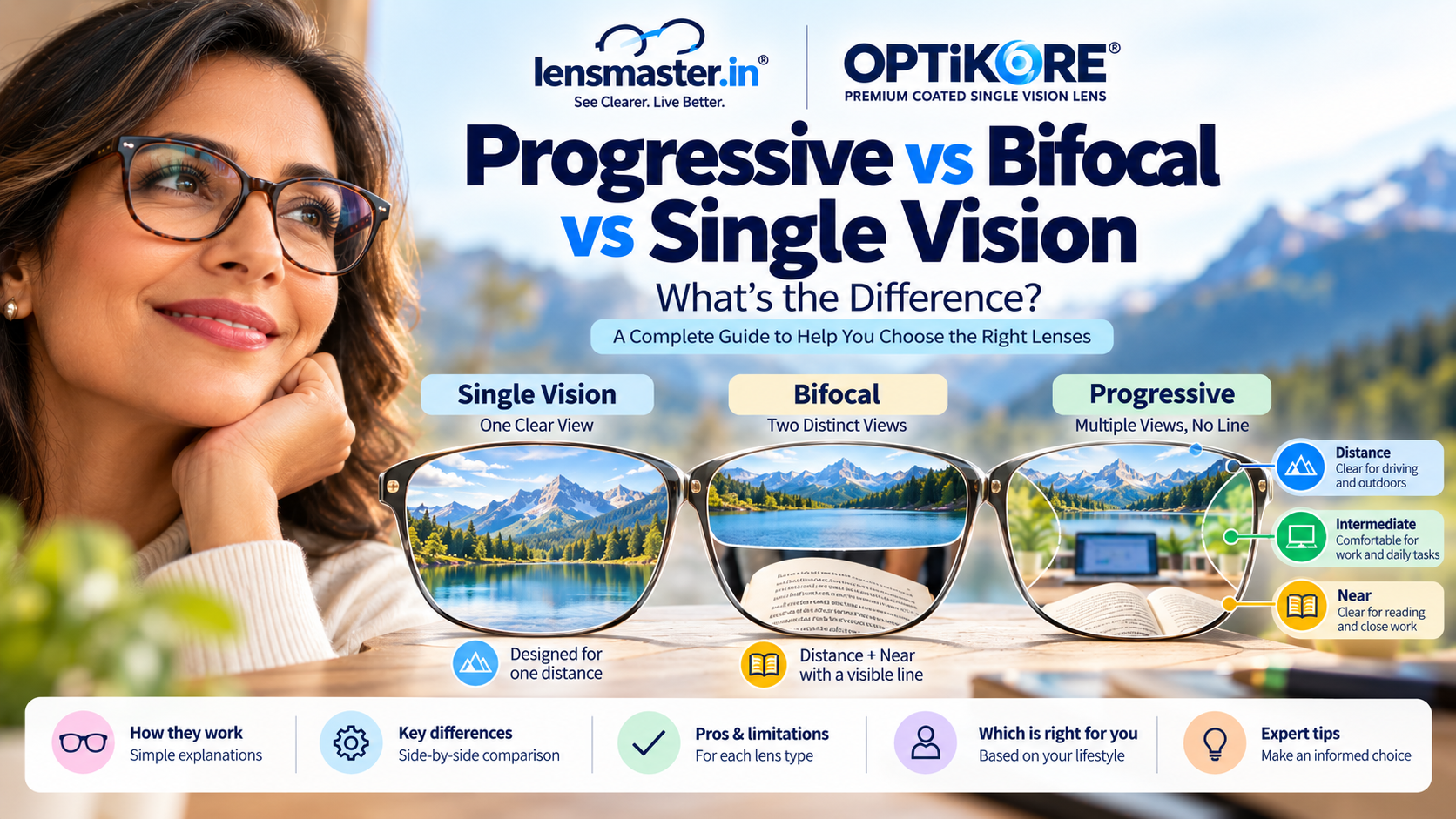
Progressive vs Bifocal vs Single Vision: What’s the Difference? Choosing the right prescription lenses can become confusing when you start needing clear vision at different distances. You may have heard of single vision, bifocal and progressive lenses, but how are they actually different? Which one is better for reading? Which is better for computer work? Are progressive lenses better than bifocals? And do you really need progressive lenses? The answer depends on your prescription, age-related vision changes, lifestyle and the distances at which you need clear vision. In this guide, we'll compare all three lens types so you can understand your options before choosing your next pair of glasses. The Simple Difference The easiest way to understand the three types is: Single vision lenses: Designed primarily for one viewing distance. Bifocal lenses: Provide two distinct areas of vision correction. Progressive lenses: Provide multiple viewing distances through a gradual change in lens power. Feature Single Vision Bifocal Progressive Distance vision ✓ ✓ ✓ Intermediate vision Depends on design Limited ✓ Near vision Depends on prescription ✓ ✓ Visible line No Yes No Multiple powers No Two Multiple Gradual transition No No Yes Typical use One main distance Distance + near Distance + intermediate + near Adaptation Usually simple May require adjustment May require adjustment What Are Single Vision Lenses? Single vision lenses have one primary optical power throughout the lens. They are commonly used for: Distance vision Reading Computer work Other specific visual requirements For example, if you are short-sighted and need glasses primarily for seeing distant objects, your prescription may be corrected with single vision lenses. Similarly, someone who only needs reading correction may use single-vision reading glasses. The advantage? The optical design is relatively straightforward, and there is generally a broad usable area across the lens. The limitation? One pair is primarily designed around one viewing distance. If you need both distance and near correction, you may need separate pairs—or consider a multifocal option. What Are Bifocal Lenses? Bifocal lenses provide two different optical powers within one lens. Traditionally: The upper portion is used for distance vision. The lower segment is used for near vision. A visible line separates the two areas. Bifocals have been used for decades and remain a useful option for some people. However, traditional bifocals don't provide the same gradual intermediate transition found in progressive lenses. What Are Progressive Lenses? Progressive lenses are multifocal lenses designed to provide vision correction at multiple distances through a gradual change in optical power. Typically: Top → Distance Middle → Intermediate Bottom → Near Unlike traditional bifocals, progressive lenses don't have a visible line separating the different areas. This creates a more continuous optical transition and a line-free appearance. If you're new to progressive lenses, read our [Complete Guide to Progressive Lenses for First-Time Buyers] and [How Do Progressive Lenses Work?]. Progressive vs Bifocal: What's the Difference? The biggest difference is how the different powers are arranged. Bifocal lenses Bifocals have two distinct optical areas. You move from the distance area to the near segment. Progressive lenses Progressive lenses gradually change optical power across the lens. This provides: Distance → Intermediate → Near without a visible dividing line. Why Is Intermediate Vision Important? Intermediate vision has become increasingly important in everyday life. Think about how often you use: Computers Laptops Tablets Car dashboards Smartphones Kitchen counters Workstations Traditional bifocals primarily separate distance and near vision. Progressive lenses include an intermediate transition between the two. However, the amount and usability of intermediate vision can vary between progressive lens designs. That's why not all progressive lenses provide exactly the same visual experience. Progressive vs Single Vision The key difference is the number of viewing distances addressed. Single vision One primary distance. Progressive Multiple viewing distances. For someone who only needs distance correction, single vision may be all they need. But someone experiencing presbyopia and needing distance, intermediate and near correction may find a progressive design more convenient. What Is Presbyopia? Presbyopia is an age-related change in the eye's ability to focus on nearby objects. You may begin noticing: Small print becoming difficult to read Holding your phone farther away Needing brighter lighting Eye strain while reading Difficulty switching between near and far objects If you already wear distance glasses, you may eventually need additional near correction. This is when your eye-care professional may discuss options such as: Reading glasses Bifocals Progressive lenses Occupational lenses Which Is Better for Reading? It depends on your needs. If you only need near correction, single-vision reading glasses may be sufficient. But if you need both distance and near vision throughout the day, switching between different pairs can become inconvenient. Progressive lenses can provide access to distance, intermediate and near vision in one pair. Which Is Better for Computer Work? Computer work generally involves an intermediate viewing distance. This makes the intermediate zone particularly important. Progressive lenses can provide intermediate vision, but the usable area depends on the particular lens design and your prescription. If you spend many hours working at a computer, an occupational or computer-specific lens may sometimes be more suitable than a general-purpose progressive. Tell your optician: How far your monitor is from your eyes How many hours you use a computer Whether you use one or multiple screens Your typical working posture How much you use your phone These details can help determine the appropriate lens solution. Which Is Better for Driving? For driving, clear distance vision is particularly important. Single vision distance lenses can be suitable if distance correction is your primary requirement. Progressive lenses can also provide distance correction while allowing intermediate and near vision for other activities. If you drive frequently, tell your eye-care professional. Your lens choice should take into account your prescription, visual requirements and fitting. Progressive Lenses: Advantages Progressive lenses can offer several benefits.
- Multiple viewing distances One pair can provide distance, intermediate and near correction.
- No visible line Progressive lenses have a line-free appearance.
- Convenience You don't need to continually switch between distance and reading glasses.
- Intermediate vision The design includes a transition between distance and near.
- Modern lens technology Many modern progressive lenses use advanced digital/freeform manufacturing techniques. Progressive Lenses: Things to Consider Progressive lenses aren't necessarily perfect for everyone. During the initial adaptation period, some wearers may notice: Peripheral blur Slight distortion Difficulty finding the near zone A sensation of movement Need to change head positioning Accurate measurements and fitting are particularly important. If vision remains unclear or uncomfortable, your glasses should be checked by an optical professional. Bifocal Lenses: Advantages Bifocals provide two distinct vision zones in one pair. Potential advantages include: Distance correction Near correction Clearly defined near area Familiar optical design No need to search through a progressive corridor For some people, this straightforward separation can be useful. Bifocal Lenses: Limitations Traditional bifocals also have some disadvantages. Visible line The separation between the two powers is visible. Limited intermediate transition Traditional bifocals don't provide the same gradual transition as progressive lenses. Image jump Some wearers notice a change in image position when moving between the distance and near segments. Appearance Some people prefer the line-free appearance of progressive lenses. Single Vision Lenses: Advantages Single vision lenses are a practical choice when you need correction for one primary distance. Benefits include: Broad usable viewing area Straightforward optical design Usually easy adaptation Often lower cost Suitable for specific visual tasks Single Vision Lenses: Limitations The main limitation is that one pair is designed around one primary viewing distance. If you need distance and reading correction, you may need separate pairs. For some people, this is perfectly acceptable. For others, the convenience of a multifocal lens may be preferable. Are Progressive Lenses Better Than Bifocals? There isn't a universal winner. Progressive and bifocal lenses solve similar problems using different optical designs. Progressive lenses may be preferred if you want: Distance + intermediate + near vision No visible line A gradual transition One pair for multiple activities Bifocals may be preferred if you want: Clearly separated distance and near zones A simpler two-zone design A clearly defined reading area Your prescription and lifestyle should determine the choice. Are Progressive Lenses Better Than Single Vision? Again, it depends. If you only need correction for one distance, single vision may be completely appropriate. If you need correction for multiple distances, progressive lenses can offer greater convenience by combining different viewing zones in one pair. Does Frame Choice Matter? Yes—especially with progressive lenses. The frame affects: Available lens height Eye position Fitting height Vertex distance Lens positioning Overall comfort A frame that looks good isn't necessarily the ideal frame for every progressive design. Your optician should check the frame before finalising your progressive lens. Does Lens Technology Matter? Yes. Modern progressive lenses can use advanced freeform digital surfacing and other design technologies. Different designs can optimise different aspects of vision, including: Distance Intermediate Near Peripheral areas Corridor design Personalisation This means two lenses can both be called "progressive" but offer different designs and characteristics.Which Lens Is Right for You? Use this as a starting point: Choose single vision if: You primarily need correction at one viewing distance. Consider bifocals if: You need distance and near correction and are comfortable with a visible line. Consider progressive lenses if: You need distance, intermediate and near vision and prefer a line-free design. But don't choose purely based on age or price. Your prescription and lifestyle matter more. A Simple Real-Life Example Imagine three people. Rahul — Distance only Rahul has difficulty seeing road signs but can comfortably read without glasses. A distance single-vision lens may meet his needs. Priya — Distance + Reading Priya needs distance correction and also needs help reading. She may consider bifocals or progressive lenses. Amit — Distance + Computer + Reading Amit drives, works on a computer and reads every day. A progressive lens may provide a convenient solution covering multiple distances. These are simplified examples. The appropriate lens depends on the individual's actual prescription and visual requirements. What Should You Ask Before Buying? Before choosing your lenses, ask your optician: What type of vision correction do I need? Do I need single vision, bifocal or progressive lenses? What are my distance and near requirements? How important is intermediate vision for me? Is my frame suitable for progressive lenses? What lens design is being recommended? What measurements are required? What coating is included? Is the lens freeform or digitally surfaced? What happens if I have difficulty adapting? Understanding these points can help you make a more informed decision. Progressive vs Bifocal vs Single Vision: Quick Decision Guide Your Requirement Lens to Consider Distance only Single Vision Reading only Single Vision Reading Distance + Near Bifocal or Progressive Distance + Computer + Near Progressive Want no visible line Progressive Prefer clearly separated zones Bifocal One primary viewing distance Single Vision Multiple daily viewing distances Progressive Frequently Asked Questions Are progressive lenses better than bifocals? Not necessarily. They are different designs. Progressive lenses provide a gradual transition across multiple distances, while bifocals provide two distinct vision zones. Are progressive lenses better than single vision? If you need multiple viewing distances, progressive lenses can be more convenient. If you only need one viewing distance, single vision may be sufficient. Can I switch from bifocals to progressive lenses? Yes, many people transition from bifocals to progressives. Adaptation varies from person to person. Do progressive lenses have a visible line? No. Progressive lenses are designed without the visible dividing line found in traditional bifocals. Are progressive lenses good for computer use? They can provide intermediate vision, but people who spend many hours at a computer may benefit from a dedicated occupational or computer lens depending on their working distance. Are bifocals cheaper than progressive lenses? Pricing depends on the lens material, design, brand, coating and other specifications. Progressive lenses can cost more, particularly when advanced designs are selected. What is the best lens for someone over 40? Age alone doesn't determine the best lens. Your prescription, lifestyle and visual requirements are more important. Final Thoughts There is no single lens that is best for everyone. Single vision is designed primarily for one viewing distance. Bifocals provide two distinct viewing zones. Progressive lenses provide multiple viewing distances through a gradual transition. The best choice is the one that matches your prescription, your lifestyle and the way you use your eyes every day. At LensMaster, our goal is to make lens technology easier to understand so you can make an informed decision with your eye-care professional. Understand your vision. Understand your lenses. Choose with confidence. Read Next Progressive Lenses: The Complete Guide for First-Time Buyers How Do Progressive Lenses Work? A Simple Guide How Long Does It Take to Adjust to Progressive Lenses? Why Are My New Progressive Lenses Blurry? Progressive Lenses for Computer Use What Are Freeform Progressive Lenses?
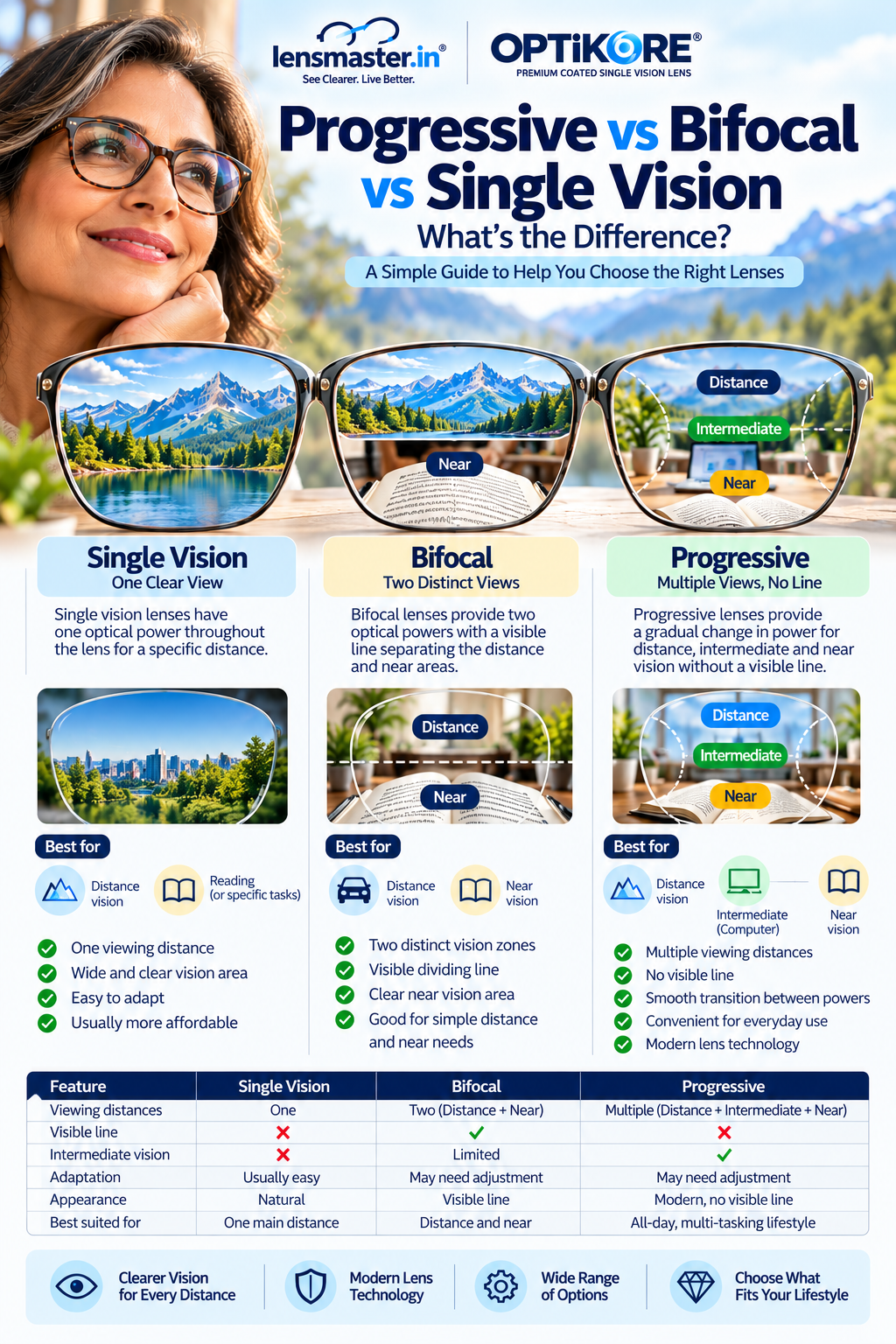 Describe this image for readers and Google
Ready for clearer vision?
Browse the OptiKore range at 40–60% off MRP, or book a free trial at a partner optician.
Explore Lenses →