Know Your Vision
Progressive Lenses: The Complete Guide for First-Time Buyers
Lensmaster Knowledge Centre • 2 October 2026
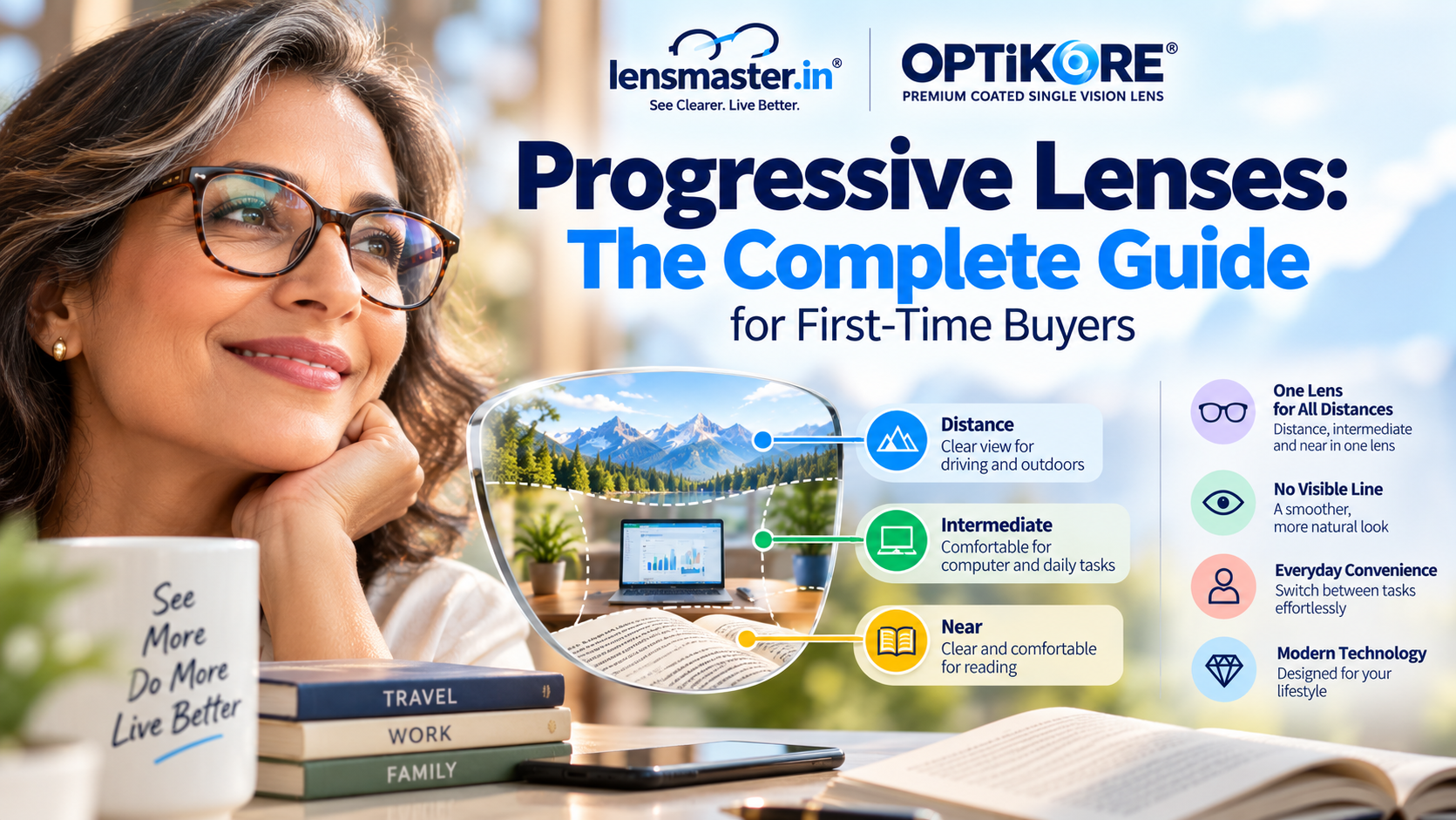
Progressive Lenses: The Complete Guide for First-Time Buyers
If you are over 40 and finding it increasingly difficult to read small text, switch between your phone and a distant object, or see clearly at different distances, you may have heard about progressive lenses.
But what exactly are progressive lenses?
How do they work? Are they better than bifocals? How long does it take to get used to them? And how do you choose the right progressive lens for your eyes?
This complete guide explains everything a first-time progressive lens wearer should know before making a decision.
What Are Progressive Lenses?
Progressive lenses are multifocal spectacle lenses designed to provide clear vision at multiple distances through a single lens.
Unlike traditional bifocal lenses, progressive lenses do not have a visible line separating the distance and reading portions.
Instead, the lens gradually changes power from the top of the lens to the bottom.
Typically:
- The upper portion is used primarily for distance vision
- The middle area supports intermediate vision
- The lower portion provides near vision
This gradual transition allows you to see objects at different distances without having to switch between different pairs of glasses.
Progressive lenses are commonly prescribed for people experiencing presbyopia, an age-related change in the eye's ability to focus on nearby objects.
Why Do People Need Progressive Lenses?
As we get older, the natural lens inside the eye gradually becomes less flexible.
This makes it harder to focus on nearby objects.
You may notice symptoms such as:
- Holding your phone farther away to read
- Difficulty reading small print
- Needing brighter light for reading
- Difficulty moving between near and far vision
- Eye strain while reading
- Difficulty seeing your computer screen clearly
- Increasing dependence on reading glasses
This condition is called presbyopia.
Progressive lenses can provide correction for distance, intermediate and near vision in one pair of spectacles.
How Do Progressive Lenses Work?
A progressive lens contains different zones of optical power.
Distance zone
The upper portion of the lens is primarily designed for seeing distant objects.
This can be useful for:
- Driving
- Watching television
- Outdoor activities
- Looking across a room
Intermediate zone
The middle area supports intermediate distances.
This is particularly important for activities such as:
- Computer work
- Looking at dashboards
- Cooking
- Working at a desk
- Interacting with people across a room
Near zone
The lower portion provides additional power for close-up tasks.
This is commonly used for:
- Reading books
- Reading your phone
- Checking documents
- Sewing
- Other close-up activities
The transition between these zones is gradual rather than separated by a visible line.
Progressive Lenses vs Bifocal Lenses
One of the most common questions first-time buyers ask is:
"What's the difference between progressive and bifocal lenses?"
The main difference is how the different vision distances are incorporated into the lens.
Feature| Progressive Lens| Bifocal Lens Distance vision| Yes| Yes Intermediate vision| Yes| Limited Near vision| Yes| Yes Visible line| No| Yes Gradual transition| Yes| No Appearance| Line-free| Visible segment Adaptation| May require adjustment| Usually simpler concept
Progressive lenses are designed to provide a continuous transition between different viewing distances, while bifocals traditionally provide two distinct areas.
Progressive vs Single Vision Lenses
Single vision lenses are designed to correct vision at one primary distance.
For example:
- Distance glasses
- Reading glasses
- Computer glasses
If someone needs correction for both distance and near vision because of presbyopia, they may need multiple pairs of single-vision glasses or a multifocal option.
Progressive lenses combine multiple viewing distances into one pair.
Who Can Benefit From Progressive Lenses?
Progressive lenses may be suitable for people who need correction for more than one viewing distance.
They are particularly common among people experiencing presbyopia.
They may be useful if you:
- Need both distance and reading correction
- Frequently switch between near and far tasks
- Want one pair of glasses for multiple activities
- Spend significant time using computers
- Drive regularly
- Read frequently
- Prefer glasses without a visible bifocal line
Your eye-care professional can determine whether progressive lenses are appropriate based on your prescription and visual requirements.
Are Progressive Lenses Difficult to Adjust To?
Some first-time wearers adapt quickly, while others need more time.
During the initial adjustment period, you may notice:
- Slight peripheral distortion
- A sensation that the floor is moving
- Difficulty finding the correct viewing area
- Mild visual discomfort
- A need to move your head differently
These sensations generally improve as you become familiar with the lens.
The fitting, prescription accuracy, lens design and frame positioning can all influence the experience.
If significant discomfort or unclear vision continues, the glasses should be checked by an optical professional.
How Long Does It Take to Adjust to Progressive Lenses?
There is no single adjustment period that applies to everyone.
Some people become comfortable within a few days, while others may require longer.
Successful adaptation can depend on:
- Whether you are a first-time progressive wearer
- Your prescription
- The amount of near addition
- Lens design
- Frame selection
- Fitting accuracy
- Your daily visual habits
The key is to wear the glasses consistently rather than repeatedly switching between old and new prescriptions unless advised otherwise by your eye-care professional.
Why Does Lens Design Matter?
Not all progressive lenses are designed in exactly the same way.
Different lens designs can vary in how they manage:
- Distance vision
- Intermediate vision
- Near vision
- Peripheral areas
- Corridor length
- Visual transitions
- Personalisation
Modern progressive lenses may use advanced digital or freeform surfacing technologies to optimise the optical design.
This is why comparing progressive lenses only by price may not tell you the whole story.
What Are Freeform Progressive Lenses?
Freeform progressive lenses are digitally designed and manufactured using advanced surfacing technology.
Instead of relying only on a traditional design, the optical surface can be calculated and produced with greater precision.
Depending on the design, this technology can be used to optimise different aspects of the wearer's visual experience.
When comparing lenses, ask about:
- Lens design
- Digital surfacing
- Corridor design
- Personalisation
- Intermediate vision
- Peripheral vision
- Prescription range
- Fitting requirements
What Is a Progressive Lens Corridor?
The corridor is the transition area through which the lens power gradually changes from distance vision toward near vision.
A progressive lens needs to provide a practical transition between these viewing distances.
The corridor design can influence how the wearer experiences intermediate vision and how easily they move their eyes between different viewing distances.
This is one reason progressive lens selection should be based on the individual's prescription and lifestyle rather than simply choosing the cheapest available option.
How Should You Choose Progressive Lenses?
The right progressive lens is not necessarily the same for everyone.
Before choosing a lens, consider your lifestyle.
If you are a frequent driver
You may want to prioritise:
- Clear distance vision
- Comfortable intermediate vision
- Good visual awareness
- Appropriate frame and fitting
If you work on a computer
Intermediate vision becomes particularly important.
You may need to consider whether a conventional progressive or an occupational/computer lens is more suitable for your work requirements.
If you read frequently
Near vision and reading comfort should receive greater attention.
If you use multiple screens
Tell your optician how much time you spend on:
- Laptop
- Desktop monitor
- Smartphone
- Tablet
Your working distances can help the optical professional determine the appropriate lens solution.
Does Frame Choice Matter for Progressive Lenses?
Yes.
Frame selection is particularly important for progressive lenses because the lens needs sufficient vertical space for the different viewing zones.
When selecting your frame, consider:
- Frame height
- Bridge position
- Frame stability
- Eye position
- Pantoscopic angle
- Distance between the eye and lens
- Overall frame fit
A frame that looks attractive may not necessarily provide the ideal geometry for every progressive lens design.
Your optician should check the frame and fitting before finalising the lens.
What Information Is Needed for Progressive Lenses?
Depending on the lens and fitting process, information may include:
- Sphere
- Cylinder
- Axis
- ADD power
- Pupillary distance
- Monocular PD
- Fitting height
- Frame measurements
For personalised progressive lenses, additional measurements may sometimes be required.
Accurate measurements are important because progressive lenses depend heavily on correct positioning.
How Much Do Progressive Lenses Cost in India?
Progressive lens prices in India can vary significantly.
Pricing depends on factors such as:
- Lens material
- Index
- Coating
- Progressive design
- Digital/freeform technology
- Personalisation
- Brand
- Prescription
- Manufacturing technology
Therefore, instead of asking only:
"How much does a progressive lens cost?"
it is useful to ask:
"What progressive lens design is appropriate for my prescription and lifestyle, and what does the price include?"
At LensMaster, we believe consumers should be able to understand the technology and value behind different lens options before making a purchase.
Are Expensive Progressive Lenses Always Better?
Not necessarily.
The most expensive lens may not automatically be the most appropriate lens for every wearer.
The important question is whether the lens design matches:
Prescription + lifestyle + frame + fitting + visual requirements.
For example, someone who spends 10 hours a day working on a computer may have different requirements from someone whose primary needs are driving and outdoor distance vision.
How to Get Better Results From Progressive Lenses
Before ordering your glasses:
- Get an accurate eye examination
Your prescription should be current and appropriate for your visual needs.
- Explain your lifestyle
Tell your optician whether you:
- Drive frequently
- Work on computers
- Read extensively
- Use smartphones
- Work outdoors
- Spend long hours in meetings
- Choose the frame carefully
Make sure the frame is stable and suitable for the progressive lens design.
- Take accurate measurements
Progressive lenses depend on accurate fitting measurements.
- Give yourself time to adapt
Do not judge a new progressive lens immediately after putting it on.
- Return for a fitting check if necessary
If vision remains uncomfortable or unclear, have the glasses checked.
Common Progressive Lens Problems
Some common complaints include:
"My progressive lenses are blurry."
Possible causes can include prescription issues, fitting measurements, lens positioning, adaptation or other optical factors.
"I can't read properly."
The near zone may need to be evaluated along with the prescription and fitting.
"My computer screen is blurry."
A conventional progressive may not always be the ideal solution for a specific workstation setup.
"I feel dizzy."
Some people experience visual discomfort during adaptation. Persistent or significant symptoms should be evaluated by an eye-care professional.
"I have to move my head a lot."
This can be related to the usable viewing zones, lens design, fitting or adaptation.
Progressive Lenses: What Should You Ask Your Optician?
Before purchasing, ask:
- Which progressive design is suitable for my prescription?
- What is the near addition?
- How important is intermediate vision for my lifestyle?
- Is this lens digitally/freeform surfaced?
- What measurements are required?
- Is my frame suitable?
- What coating is included?
- What happens if I have difficulty adapting?
- Is there a remake or adaptation policy?
- What is included in the quoted price?
These questions can help you make a more informed decision.
How LensMaster Helps You Understand Progressive Lenses
At LensMaster, our goal is to make lens selection easier to understand.
Instead of looking at progressive lenses simply as different price points, we believe consumers should understand the relationship between:
Prescription → Lifestyle → Lens Design → Fitting → Visual Experience
LensMaster provides information about different lens technologies and helps consumers understand the differences between lens options before making a purchase.
Explore our progressive lens range to understand which designs may suit different visual requirements.
Frequently Asked Questions
Are progressive lenses better than bifocals?
Progressive and bifocal lenses serve similar multifocal needs but use different optical designs. Progressive lenses provide a gradual transition without a visible line, while traditional bifocals have distinct distance and near areas.
Are progressive lenses good for computer work?
They can be useful for computer users, but the appropriate solution depends on the working distance and visual requirements. Some people may benefit from dedicated occupational or computer lenses.
How long does it take to get used to progressive lenses?
Adjustment varies from person to person. Some wearers adapt quickly, while others require more time.
Can I drive with progressive lenses?
Progressive lenses can be used for driving when properly prescribed and fitted. Distance vision and the individual's visual requirements should be assessed by an eye-care professional.
Can progressive lenses be used in small frames?
Some progressive designs can work with smaller frames, but sufficient vertical space and appropriate fitting are important. Frame suitability should be checked before ordering.
What is ADD power in progressive lenses?
ADD, or addition power, is the additional optical power prescribed for near vision in multifocal lenses.
Are progressive lenses worth the price?
That depends on your prescription, lifestyle, lens requirements and budget. The most suitable lens is one that appropriately meets your visual needs rather than simply being the most expensive option.
Final Thoughts
Progressive lenses have evolved significantly from the early days of multifocal eyewear.
Modern designs can incorporate digital surfacing, advanced optical calculations and personalised fitting approaches to provide vision correction across different distances.
But the technology alone is not enough.
A successful progressive lens experience depends on the combination of:
The right prescription + the right lens design + the right frame + accurate fitting + proper adaptation.
If you're buying progressive lenses for the first time, don't choose based only on price.
Understand your visual needs first.
Then choose a lens designed around those needs.
LensMaster — helping you understand your lenses before you choose them.
Related LensMaster Guides
- Progressive vs Bifocal vs Single Vision
- How Long Does It Take to Adjust to Progressive Lenses?
- Why Are My New Progressive Lenses Blurry?
- Progressive Lenses for Computer Use
- How to Read a Progressive Lens Prescription
- What Are Freeform Progressive Lenses?
- How to Choose the Right Progressive Lenses
- Progressive Lens Price in India
Ready for clearer vision?
Browse the OptiKore range at 40–60% off MRP, or book a free trial at a partner optician.
Explore Lenses →