Know Your Vision
How Long Does It Take to Adjust to Progressive Lenses? A Complete Guide for First-Time Wearers
Lensmaster Knowledge Centre • 14 October 2026
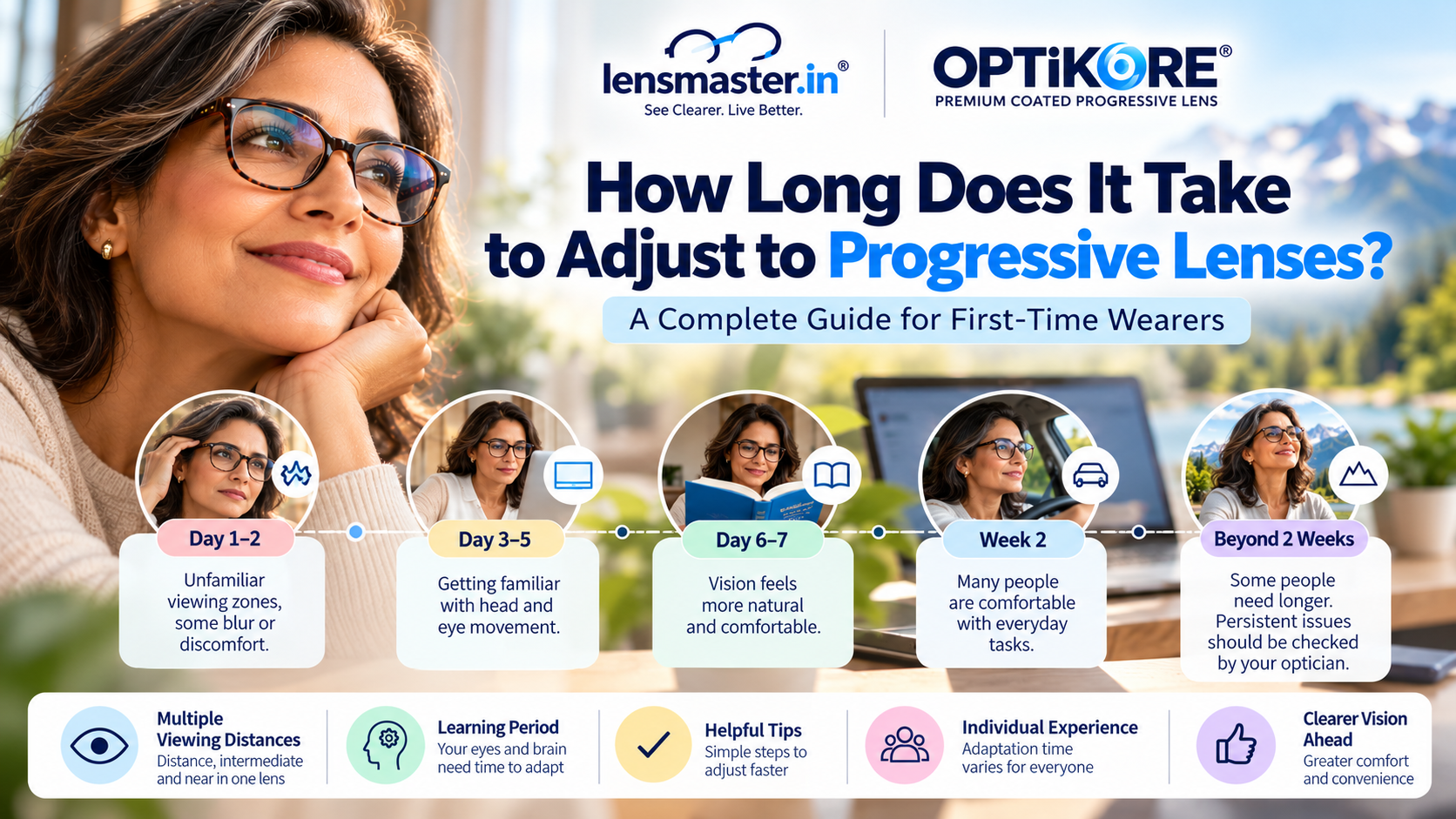
How Long Does It Take to Adjust to Progressive Lenses? A Complete Guide for First-Time Wearers
LensMaster Knowledge Centre | Progressive Lens Guides
You've finally received your new progressive glasses. You're excited about seeing clearly at different distances without constantly switching between reading and distance glasses.
But something feels different.
The floor may look slightly curved. Your computer screen might seem difficult to focus on. You may find yourself moving your head more than usual.
Don't worry—some initial adjustment is common when wearing progressive lenses for the first time.
Most people who successfully adapt become comfortable within a few days to around two weeks, although some may need longer. There is no fixed adjustment period, and persistent problems should be professionally checked.
In this guide, we'll explain why progressive lenses take time to get used to, what you may experience, and how to make the transition more comfortable.
Why Do Progressive Lenses Require an Adjustment Period?
Unlike single vision lenses, which have one primary optical power, progressive lenses provide multiple viewing distances within a single lens.
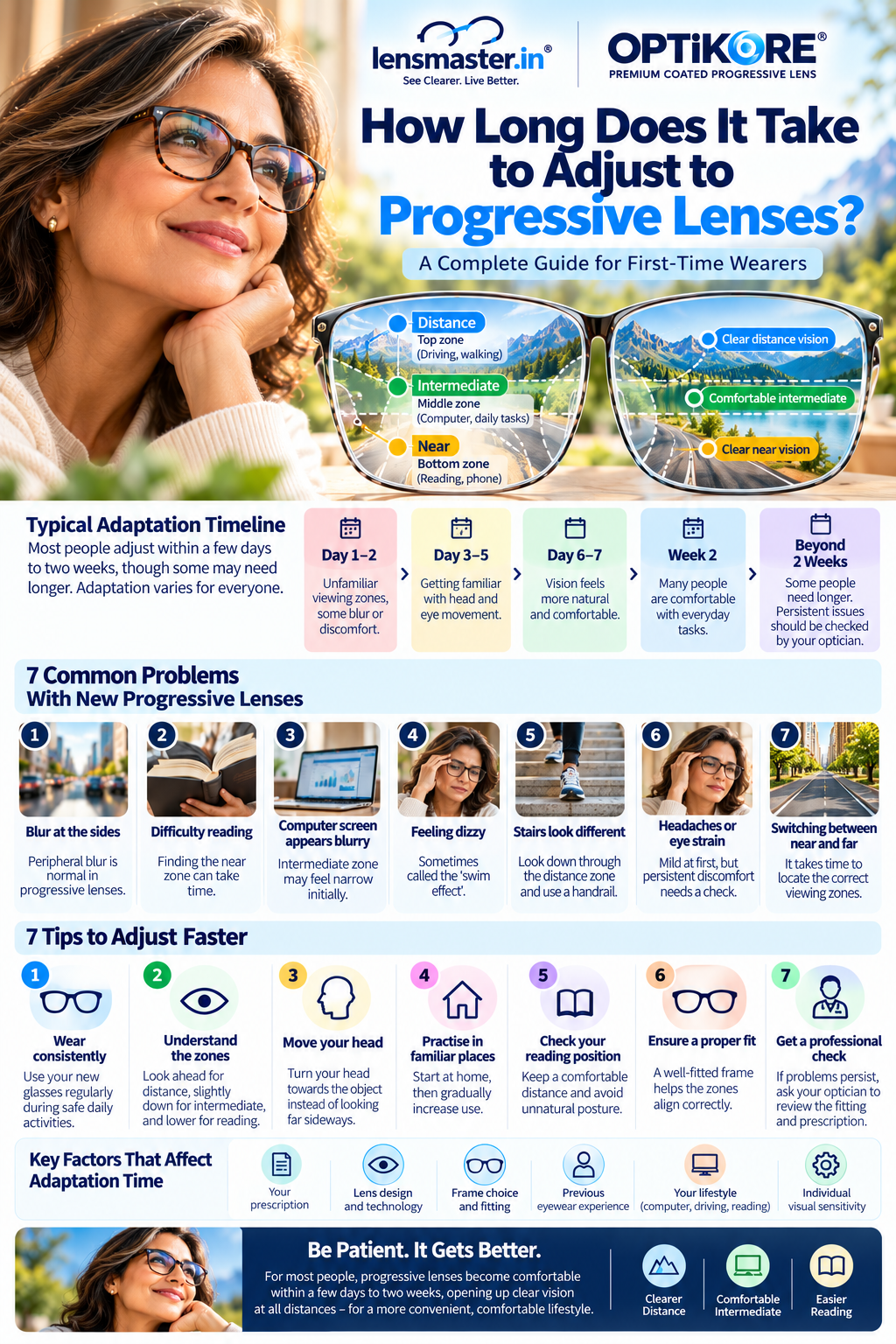
A typical progressive lens has three functional areas:
- Distance zone: For driving, walking and looking at distant objects.
- Intermediate zone: For computers, dashboards and everyday activities.
- Near zone: For reading books, smartphones and close-up tasks.
The power changes gradually between these areas.
However, the peripheral portions of progressive lenses may introduce unwanted blur or distortion.
Your visual system needs to become familiar with using the appropriate viewing zones.
This learning process is called progressive lens adaptation.
How Long Does Progressive Lens Adaptation Take?
The following timeline is illustrative, not a guaranteed progression.
Period| What You May Experience Days 1–2| Unfamiliar viewing zones, peripheral blur or mild discomfort Days 3–5| Increasing familiarity with head and eye positioning Days 6–7| Some wearers become noticeably more comfortable Week 2| Many successful adapters are comfortable with everyday tasks Beyond 2 weeks| Some people need longer; persistent problems warrant professional assessment
Adaptation depends on your prescription, lens design, fitting accuracy, previous eyewear and individual sensitivity.
Important: Severe dizziness, sudden vision changes, significant pain or other concerning symptoms should not be dismissed as normal adaptation. Seek appropriate medical assessment.
Seven Common Problems With New Progressive Lenses
- Blurry Vision at the Sides
Progressive lenses have areas of peripheral blur because of the optical design required to provide multiple powers in one lens.
You may notice distortion when looking sideways without moving your head.
What helps?
Try turning your head slightly toward the object you want to see, keeping it within the appropriate viewing area.
If the blur is excessive or affects central vision, have your glasses checked.
- Difficulty Reading
You may initially struggle to find the near viewing zone.
What helps?
Look through the lower portion of the lens while keeping reading material at a comfortable distance. Small adjustments in head position may help.
Persistent reading difficulties can indicate a problem with the prescription, fitting height or lens design.
- Computer Screen Appears Blurry
Computer screens are generally viewed at an intermediate distance.
The intermediate zone in general-purpose progressive lenses can be narrower than the distance or near areas.
What helps?
Adjust your monitor position and discuss your actual screen distance with your optician.
People who work extensively on computers may benefit from occupational lenses designed specifically for their working distances.
- Feeling Dizzy While Walking
Some new wearers experience a sensation of movement or distortion.
This is sometimes described as the swim effect.
What helps?
Start using the glasses in a familiar, safe environment. Move carefully and use handrails on stairs when necessary.
Do not drive or perform potentially hazardous activities until your vision feels stable and comfortable.
Persistent or significant dizziness needs professional assessment.
- Difficulty Looking Down at Stairs
When you look downward through progressive lenses, your eyes may pass through the near viewing area.
This can make stairs or changes in floor level look unfamiliar.
What helps?
Lower your head to view the stairs through the distance portion of the lenses, and use a handrail while adapting.
- Headaches or Eye Strain
Mild discomfort can occur during adaptation, but headaches may also result from prescription or fitting problems.
What helps?
Avoid forcing yourself through significant discomfort. Have your glasses checked if headaches persist, worsen or interfere with daily activities.
- Difficulty Switching Between Near and Far Vision
You may initially need time to locate the correct viewing zones.
With experience, these movements can become more natural.
Seven Practical Tips to Adjust to Progressive Lenses
Tip 1: Wear Your New Glasses Consistently
Regular use during safe everyday activities can help you become familiar with the lenses.
Avoid repeatedly switching between old and new glasses unless your eye-care professional advises it.
Tip 2: Learn the Three Viewing Zones
Remember this simple rule:
Look straight ahead for distance.
Look slightly downward for intermediate tasks.
Look through the lower portion for reading.
These are general guidelines; exact viewing positions depend on the design and fitting.
Tip 3: Move Your Head Naturally
Progressive lenses often require more head movement than single vision lenses.
Instead of looking far sideways through the peripheral portion, turn your head toward the object.
Tip 4: Practise in Familiar Surroundings
Begin with everyday activities such as watching television, reading and moving around your home.
Gradually increase your use as you become comfortable.
Tip 5: Check Your Reading Position
Hold your book or phone at a comfortable distance.
Avoid lifting or lowering your chin excessively to force the text into focus.
If you must maintain an uncomfortable posture, your glasses may need adjustment.
Tip 6: Ensure Your Frame Fits Correctly
Even a well-designed progressive lens can perform poorly when the frame is incorrectly positioned.
The frame should sit securely and comfortably without slipping.
Tip 7: Ask for a Professional Fitting Check
If you are struggling, don't assume you simply need more time.
Your optician can check the prescription, fitting height, pupillary distance and frame positioning.
Why Do Some People Adjust Faster Than Others?
Several factors influence adaptation.
Previous experience: Someone who has worn progressive lenses before may already understand how to use the different zones.
Prescription changes: Larger changes in prescription or near addition can affect the experience.
Lens design: Different progressive designs distribute distance, intermediate, near and peripheral optical characteristics differently.
Fitting accuracy: Correct measurements help position the lens zones where they are intended to be used.
Lifestyle: Someone who spends long hours working across multiple monitors may have different requirements from someone who mainly drives and reads.
Individual sensitivity: People vary in how they respond to new optical designs.
Does Progressive Lens Technology Affect Adaptation?
Yes, lens design can influence the visual experience.
Modern progressive lenses may incorporate:
- Digital freeform surfacing
- Optimised viewing zones
- Prescription-specific calculations
- Different corridor designs
- Individual fitting parameters
- Peripheral optical optimisation
However, premium technology does not guarantee instant adaptation or eliminate all peripheral distortion.
The best progressive lens is one that appropriately matches your prescription, visual requirements and fitting conditions.
Can the Wrong Frame Cause Progressive Lens Problems?
Yes.
Frame selection and positioning can significantly influence progressive lens performance.
Important factors include:
- Frame height
- Monocular pupillary distance
- Fitting height
- Pantoscopic tilt
- Vertex distance
- Frame stability
A frame that slips down your nose can change how your eyes align with the lens zones.
This is why accurate dispensing is especially important for progressive lenses.
Standard vs Premium Progressive Lenses: Does It Make a Difference?
Progressive lenses are available in different designs and price categories.
Some advanced designs provide different balances of usable viewing areas, peripheral distortion and personalisation.
However, the word premium alone does not tell you how a lens will perform.
Before purchasing, ask your optician:
- Which lens design is suitable for my lifestyle?
- How much intermediate vision do I need?
- What measurements are required?
- Is the frame compatible with the selected design?
- What is the adaptation or remake policy?
A properly selected and fitted lens is more important than choosing a product based only on its price.
When Should You Contact Your Optician?
Arrange a professional check if:
- Your vision remains blurry in the intended viewing zones.
- You need an uncomfortable head position to see clearly.
- You experience persistent headaches or dizziness.
- Your glasses repeatedly slip or feel incorrectly positioned.
- You cannot comfortably perform important daily tasks.
- You are not making progress after several days of use.
You do not need to wait two weeks if something clearly feels wrong.
How LensMaster Helps First-Time Progressive Lens Buyers
At LensMaster.in, we believe progressive lens selection should begin with understanding your visual requirements.
The right combination matters:
Prescription + Lens Design + Frame Selection + Accurate Fitting + Adaptation
LensMaster helps consumers explore progressive lens technologies and understand what to discuss with their optical professional before buying.
Through participating retail partners, customers can seek in-person assistance with lens selection and fitting, subject to service availability.
Our goal is simple: help you make an informed lens purchase rather than choosing solely on price.
Frequently Asked Questions
How many days does it take to adjust to progressive lenses?
Some people become comfortable within a few days, while others take around two weeks or longer. Adaptation varies individually.
Is it normal for new progressive lenses to feel blurry?
Some peripheral blur is characteristic of progressive lenses. Persistent blur in the intended central viewing zones should be checked.
Can progressive lenses cause dizziness?
Some new wearers experience temporary visual discomfort or a swim sensation. Persistent, severe or worsening dizziness requires assessment.
Should I wear progressive lenses all day?
Consistent use can support adaptation, but follow your eye-care professional's instructions and avoid activities that are unsafe while your vision feels unstable.
Why can't I see my computer clearly with progressive lenses?
Your monitor may not align comfortably with the intermediate zone. Lens design, prescription, workstation setup or fitting may also contribute.
Can I drive immediately with new progressive lenses?
Drive only when your vision is clear, stable and comfortable and you meet applicable vision requirements. If uncertain, consult your eye-care professional.
What if I cannot adjust to progressive lenses?
Have the prescription, frame fit, measurements and lens design reviewed. Some people may benefit from adjustments, a different progressive design or an alternative lens solution.
Are expensive progressive lenses easier to adapt to?
Not necessarily. Advanced designs may offer useful optical features, but adaptation depends on the individual and the complete prescription-and-fitting solution.
Final Thoughts
Adjusting to progressive lenses is a learning experience for many first-time wearers.
Some people become comfortable quickly, while others need additional time or professional adjustments.
The key is not simply to wait.
Understand the viewing zones, use your glasses safely, ensure accurate fitting and seek professional advice when something doesn't feel right.
At LensMaster, we believe better lens decisions begin with better information.
LensMaster.in — See Clearer. Live Better.
Related Reading
- Progressive Lenses: The Complete Guide for First-Time Buyers
- How Do Progressive Lenses Work?
- Progressive vs Bifocal vs Single Vision
- Why Are My New Progressive Lenses Blurry?
- Progressive Lenses for Computer Use
 Describe this image for readers and Google
Ready for clearer vision?
Browse the OptiKore range at 40–60% off MRP, or book a free trial at a partner optician.
Explore Lenses →