Know Your Vision
How Do Progressive Lenses Work? A Simple Guide
Lensmaster Knowledge Centre • 3 October 2026
How Do Progressive Lenses Work? A Simple Guide
Have you ever wondered how one pair of glasses can help you see clearly when you're driving, working on a computer, checking your phone and reading a book?
That's the idea behind progressive lenses.
Unlike single-vision lenses, which are designed primarily for one viewing distance, progressive lenses contain multiple areas of optical power that transition gradually across the lens.
This allows you to see at different distances through one pair of glasses—without the visible line found in traditional bifocals.
In this guide, we'll explain how progressive lenses work, what the different vision zones do, why adaptation can take time, and how to choose a design suited to your lifestyle.
What Are Progressive Lenses?
Progressive lenses are multifocal spectacle lenses designed to provide correction for:
- Distance vision
- Intermediate vision
- Near vision
The optical power changes gradually from the upper portion of the lens to the lower portion.
This creates a continuous progression rather than two or three visibly separated lens segments.
Progressive lenses are commonly prescribed to people with presbyopia, an age-related change that makes focusing on nearby objects increasingly difficult.
If you want a broader introduction, read our [Complete Guide to Progressive Lenses for First-Time Buyers].
How Does a Progressive Lens Work?
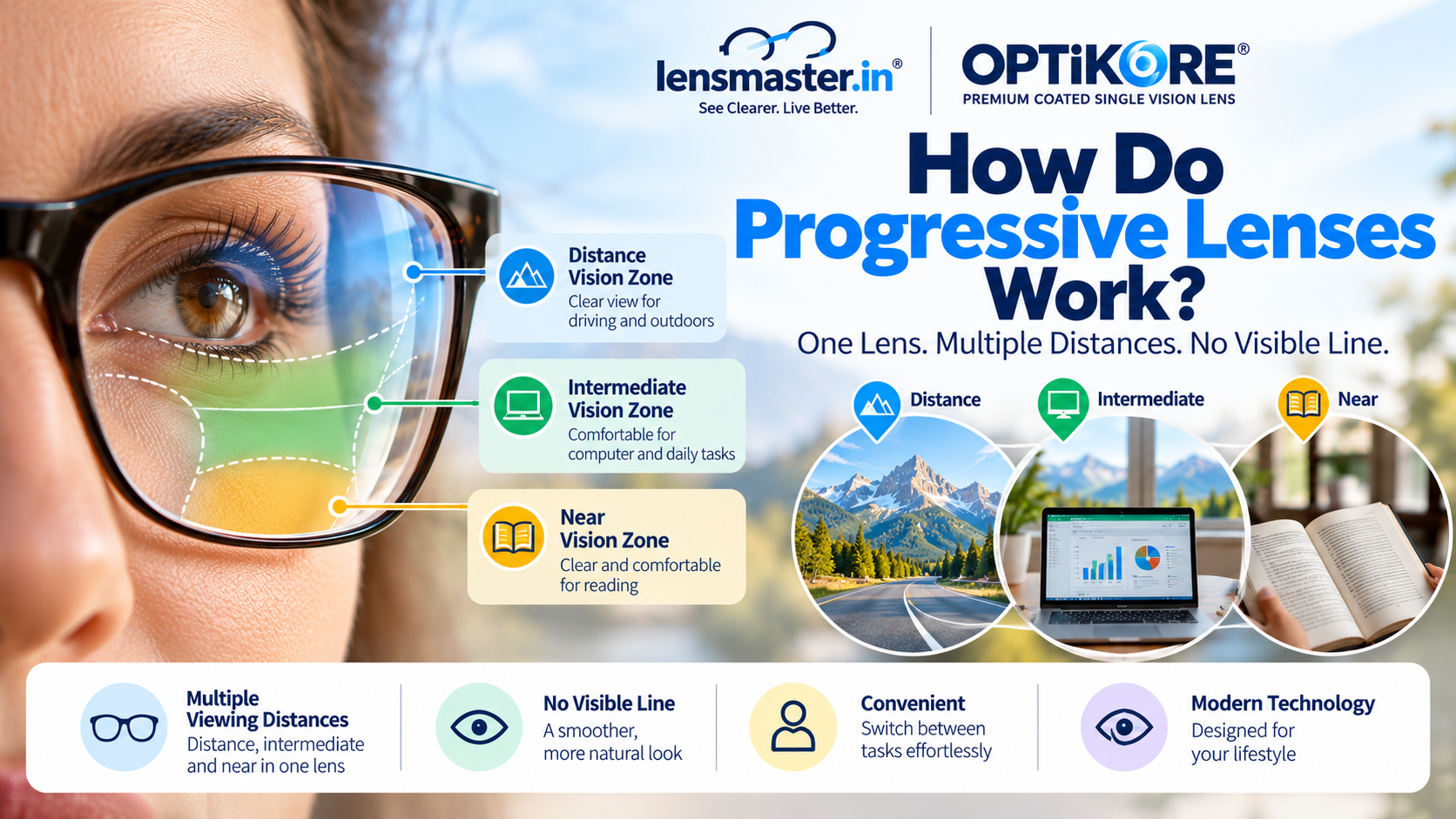
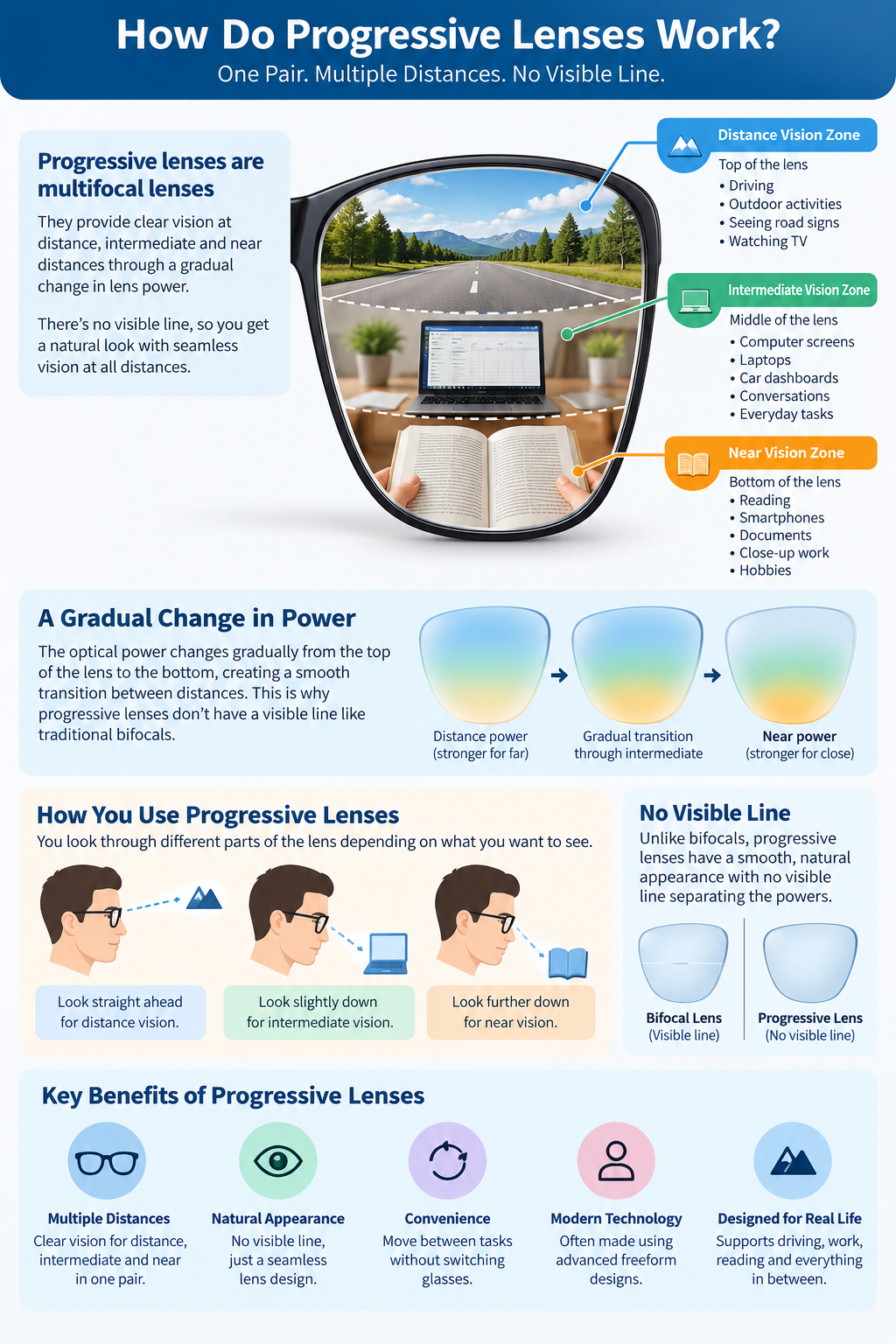
The easiest way to understand a progressive lens is to imagine the lens divided into three functional areas.
1. Distance Vision Zone
The upper part of the lens is primarily used for seeing distant objects.
You may use this area when:
- Driving
- Watching television
- Looking across a room
- Walking outdoors
- Looking at road signs
2. Intermediate Vision Zone
The central transition area supports intermediate viewing distances.
This can be particularly useful for:
- Computer screens
- Laptop screens
- Car dashboards
- Cooking
- Conversations
- Working at a desk
3. Near Vision Zone
The lower portion of the lens provides additional power for close-up tasks.
You may use it for:
- Reading
- Looking at your smartphone
- Reading documents
- Sewing
- Other close-up activities
The important point is that these zones aren't separated by visible lines.
The power changes progressively from one area to another.
Why Don't Progressive Lenses Have a Visible Line?
Traditional bifocal lenses contain two distinct optical powers, usually separated by a visible segment.
Progressive lenses use a different optical design.
The change in optical power occurs gradually across the lens.
This creates a smooth transition between distance and near vision and gives the lens its characteristic no-line appearance.
This is one of the reasons progressive lenses are sometimes described as no-line bifocals, although technically progressive lenses and bifocals are different lens designs.
What Is the Progressive Corridor?
One of the most important concepts in progressive lenses is the progressive corridor.
The corridor is the transition area through which the optical power gradually changes from distance correction toward near correction.
You can think of it as a pathway through the lens.
The corridor connects:
Distance → Intermediate → Near
The design and length of this corridor can influence how the wearer experiences different viewing distances.
Different progressive lens designs use different approaches to balancing:
- Distance vision
- Intermediate vision
- Near vision
- Peripheral areas
Why Is Peripheral Vision Different With Progressive Lenses?
Unlike a single-vision lens, a progressive lens has continuously changing optical power across its surface.
The central viewing zones are designed for the primary vision distances, while the peripheral areas may contain unwanted optical effects or distortion.
This can sometimes create sensations such as:
- Slight swim
- Peripheral blur
- Difficulty when moving the head quickly
- A feeling that objects move slightly
- Initial discomfort
These effects are one reason some first-time wearers need an adjustment period.
Modern progressive designs use advanced optical calculations to manage these effects, but no progressive design completely eliminates the fundamental optical challenges of creating multiple powers on one lens surface.
Why Do You Have to Move Your Head With Progressive Lenses?
A common experience for first-time progressive wearers is learning to use the appropriate part of the lens.
With single-vision lenses, most of the lens provides essentially the same optical correction.
With progressive lenses, different parts of the lens are designed for different viewing distances.
For example, if you're reading something on your right side, you may naturally turn your head slightly so that the text moves into the appropriate viewing zone.
Over time, this usually becomes much more natural.
Why Is the Middle Area Important?
The intermediate zone is one of the most important differences between progressive lenses and traditional bifocals.
Modern life involves many intermediate-distance tasks.
Think about:
- Desktop monitors
- Laptops
- Car dashboards
- Kitchen counters
- Shopping
- Conversations
- Smartphones held at arm's length
A progressive lens attempts to provide a useful transition between distance and near vision rather than jumping directly from one to the other.
However, the amount of usable intermediate area varies between lens designs.
Why Do Some Progressive Lenses Feel Easier to Use?
Not all progressive lenses have the same optical design.
Different designs may vary in:
- Corridor length
- Near-zone width
- Intermediate-zone width
- Peripheral management
- Prescription range
- Personalisation
- Digital surfacing
- Frame requirements
This is why simply comparing progressive lenses by brand or price doesn't tell the entire story.
Two lenses can both be described as "progressive" while providing different design characteristics.
What Are Freeform Progressive Lenses?
Modern freeform progressive lenses are digitally designed and manufactured using advanced surfacing technology.
The lens surface can be calculated using sophisticated mathematical models to control the distribution of optical power across the lens.
Depending on the design, freeform technology can be used to optimise areas such as:
- Distance vision
- Intermediate vision
- Near vision
- Peripheral areas
- Corridor behaviour
- Individual prescription requirements
Freeform technology is therefore an important development in modern progressive lens manufacturing.
How Does Your Prescription Affect a Progressive Lens?
Your prescription is one of the most important factors in progressive lens design.
A typical prescription can contain:
SPH — sphere power
CYL — cylinder power
AXIS — orientation of astigmatism correction
ADD — additional power for near vision
The ADD value is particularly important for progressive lenses because it determines the additional near correction required.
However, the prescription is only one part of the equation.
The lens also needs to be correctly fitted to your face and frame.
Why Are Measurements So Important?
Progressive lenses are highly dependent on positioning.
Important measurements can include:
- Pupillary distance
- Monocular PD
- Fitting height
- Frame dimensions
- Vertex distance
- Pantoscopic angle
- Frame alignment
Even a sophisticated lens design cannot perform as intended if it is positioned incorrectly.
This is why progressive lenses should be fitted carefully by a qualified optical professional.
Does the Frame Affect How Progressive Lenses Work?
Yes.
The frame determines how much physical space is available for the progressive design.
A frame that is too shallow may restrict the available vertical space.
Frame fit also affects:
- Eye position
- Lens height
- Vertex distance
- Frame stability
- Viewing zones
Therefore, choosing the frame and choosing the progressive lens should ideally be considered together.
How Do Progressive Lenses Help With Presbyopia?
Presbyopia occurs as the eye's natural focusing system becomes less able to accommodate for near objects.
A person who previously saw both far and near objects comfortably may begin noticing that close objects are harder to focus on.
Progressive lenses compensate optically by adding the required near power while maintaining distance correction.
The result is a single pair of glasses designed to support multiple viewing distances.
Why Do New Progressive Lenses Sometimes Feel Strange?
Your brain and eyes have to learn how to use the new optical environment.
You may initially notice:
- Peripheral distortion
- Difficulty locating the reading area
- Mild visual discomfort
- A sensation of movement
- Difficulty judging where to look
This is generally called adaptation.
The experience varies considerably from person to person.
If problems remain significant or vision is not clear, the glasses should be checked by an optical professional rather than assuming that discomfort is simply part of adaptation.
How Long Does Progressive Lens Adaptation Take?
There is no universal adjustment period.
Some people become comfortable within a few days.
Others may need longer.
Adaptation can depend on:
- Previous experience with multifocal lenses
- Prescription
- ADD power
- Lens design
- Frame
- Fitting accuracy
- Visual habits
- Individual sensitivity
Consistent use can help many people become familiar with the different viewing zones.
Progressive Lenses and Computer Use
Computer users often need a substantial amount of intermediate vision.
A standard progressive lens can provide intermediate vision, but the usable area depends on the lens design and the individual's working distance.
If you spend many hours every day at a computer, tell your optician about:
- Screen distance
- Monitor height
- Number of screens
- Typical working posture
- Smartphone usage
- Reading distance
Depending on your requirements, a dedicated occupational or computer lens may sometimes be more appropriate.
Read our upcoming guide:
Progressive Lenses for Computer Use: Are They Right for You?
Progressive Lenses for Driving
Progressive lenses can be suitable for driving when the prescription is appropriate and the lenses are correctly fitted.
The distance area is particularly important for:
- Road signs
- Traffic
- Pedestrians
- Other vehicles
- Outdoor visibility
However, driving requirements vary between individuals.
If you drive frequently, tell your optician so your visual requirements can be considered when selecting the lens design.
Progressive Lenses vs Bifocals
Here's a simple comparison:
| Feature | Progressive | Bifocal | |---|---|---| | Distance correction | Yes | Yes | | Intermediate correction | Yes | Limited/distinct | | Near correction | Yes | Yes | | Visible line | No | Yes | | Gradual transition | Yes | No | | Adaptation | May take time | Often simpler | | Appearance | Line-free | Visible segment |
Neither design is automatically appropriate for everyone.
The choice depends on prescription, visual requirements, lifestyle, fitting and personal preference.
Progressive Lenses vs Single Vision
Single-vision lenses provide correction for one primary viewing distance.
Progressive lenses combine multiple viewing distances into one lens.
For someone with presbyopia who needs both distance and near correction, progressive lenses can reduce the need to switch between separate pairs of glasses.
What Makes a Good Progressive Lens?
A good progressive lens should be considered as a complete optical solution rather than simply a product category.
Important factors include:
1. Accurate prescription
The prescription must be appropriate.
2. Appropriate lens design
The design should match the wearer's visual needs.
3. Accurate measurements
Correct fitting is essential.
4. Suitable frame
The frame must provide appropriate space and positioning.
5. Lifestyle matching
Driving, computer work, reading and other activities can influence lens selection.
6. Professional fitting
Accurate dispensing and fitting can make a significant difference to the overall experience.
Frequently Asked Questions
Do progressive lenses have three separate lenses?
No. A progressive lens is a single lens with continuously changing optical power designed to provide different viewing distances.
Can progressive lenses correct distance and reading vision?
Yes. Progressive lenses are designed to provide distance, intermediate and near vision correction in one lens.
Why are progressive lenses blurry on the sides?
Peripheral blur can occur because of the optical design required to provide multiple powers across a single lens. Modern designs aim to manage these effects.
Do all progressive lenses work the same way?
No. Progressive lens designs can differ significantly in their optical design, corridor, zones, personalisation and manufacturing technology.
Are freeform progressive lenses better?
Freeform technology allows sophisticated digital control of the lens surface, but the most appropriate design depends on the individual's prescription, lifestyle and fitting requirements.
Can progressive lenses be used for computers?
They can provide intermediate vision, but people who spend long hours at a computer may have different requirements from someone who primarily needs general-purpose everyday vision.
Why is accurate fitting important?
Because the viewing zones need to be correctly positioned relative to your eyes. Incorrect positioning can affect the visual experience.
Final Thoughts
Progressive lenses work by combining multiple optical powers into a single lens with a gradual transition from distance to intermediate and near vision.
The technology may sound complicated, but the principle is simple:
One lens. Multiple viewing distances. No visible bifocal line.
However, the performance of a progressive lens depends on much more than the lens itself.
Prescription, lens design, frame selection, measurements and fitting all work together.
If you're considering progressive lenses for the first time, start by understanding your visual needs and then discuss the appropriate lens design with your eye-care professional.
LensMaster — helping you understand your lenses before you choose them.
Related Reading
- Progressive Lenses: Complete Guide for First-Time Buyers
- Progressive vs Bifocal vs Single Vision
- How Long Does It Take to Adjust to Progressive Lenses?
- Why Are My New Progressive Lenses Blurry?
- What Are Freeform Progressive Lenses?
- Progressive Lenses for Computer Use
 Describe this image for readers and Google
Ready for clearer vision?
Browse the OptiKore range at 40–60% off MRP, or book a free trial at a partner optician.
Explore Lenses →