Know Your Vision
Are Progressive Lenses Worth It? Benefits, Drawbacks & What You Should Know Before Buying
Lensmaster Knowledge Centre • 16 October 2026
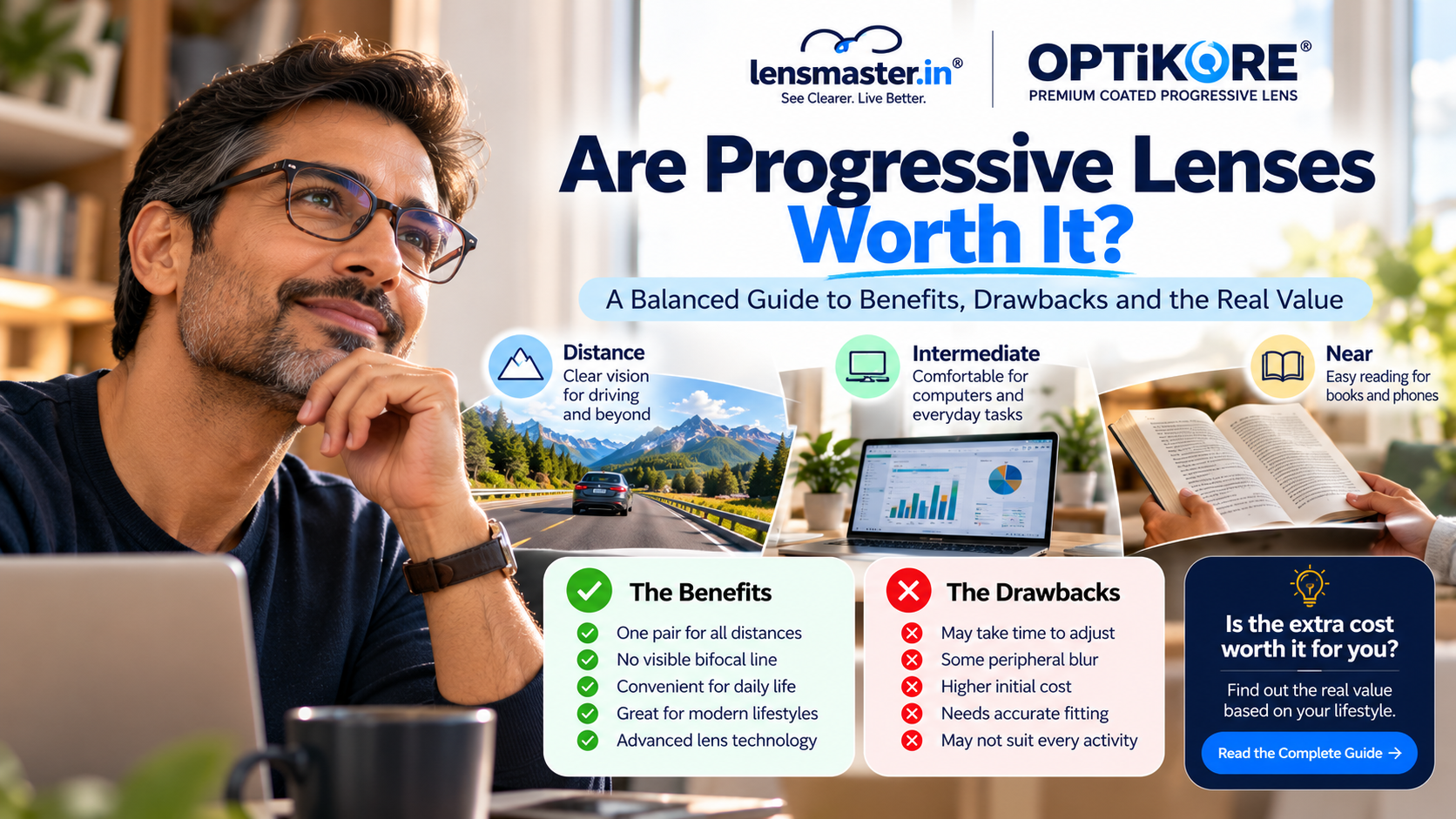
Are Progressive Lenses Worth It? Benefits, Drawbacks & What You Should Know Before Buying
LensMaster Knowledge Centre | Progressive Lens Buying Guide
Imagine you're driving and can see the road clearly, but when you glance at your phone after parking, the text appears blurry. You put on your reading glasses, only to remove them again when you look into the distance.
Sound familiar?
For millions of adults, especially after the age of 40, switching between different pairs of glasses becomes part of everyday life.
That's where progressive lenses come in.
But progressive lenses are often more expensive than regular single vision or bifocal lenses.
So the question is:
Are progressive lenses really worth the extra money?
The short answer is yes, for many people who need clear vision at multiple distances—but not necessarily for everyone.
The real value depends on your prescription, lifestyle, lens design, fitting accuracy and how frequently you switch between distance, intermediate and near vision.
Let's explore what makes progressive lenses worthwhile, where they have limitations, and how to decide whether they're right for you.
What Are Progressive Lenses?
Progressive lenses are multifocal spectacle lenses that combine different optical powers within a single lens.
They are designed to provide vision correction across three main distances:
- Distance vision: Driving, walking, watching television and outdoor activities.
- Intermediate vision: Computer screens, dashboards and everyday working distances.
- Near vision: Reading, smartphones and close-up tasks.
Unlike traditional bifocal lenses, progressive lenses do not have a visible dividing line.
Instead, the optical power gradually changes from the upper portion to the lower portion.
This means you can access different viewing distances without repeatedly changing glasses.
For a detailed explanation, read our guide: How Do Progressive Lenses Work?
Why Do People Need Progressive Lenses After 40?
As we age, the natural lens inside the eye gradually loses its ability to change focus.
This condition is known as presbyopia.
Presbyopia commonly becomes noticeable during the early-to-mid 40s, although the timing varies.
You may experience:
- Difficulty reading small print
- Holding your phone farther away
- Needing brighter light for reading
- Difficulty focusing on nearby objects
- Frequent switching between reading and distance glasses
- Eye strain during close-up activities
If you already wear distance glasses, presbyopia may create a need for additional near correction.
Progressive lenses can combine these corrections into one pair.
Seven Benefits That Make Progressive Lenses Worth Considering
- One Pair of Glasses for Multiple Distances
This is perhaps the biggest practical advantage.
Instead of carrying separate reading and distance glasses, progressive lenses provide multiple viewing zones in one pair.
Imagine a typical day:
You drive to work, use your laptop, attend meetings, check your phone and read a book before sleeping.
Progressive lenses can support these different viewing distances without requiring constant switching.
For people with busy lifestyles, this convenience can be valuable.
- No Visible Bifocal Line
Traditional bifocals have a visible line separating distance and near correction.
Progressive lenses have a line-free appearance.
Many wearers prefer this design because it looks similar to ordinary single vision glasses.
- Intermediate Vision for Modern Lifestyles
Today's visual requirements are different from those of previous generations.
We spend considerable time using:
- Desktop computers
- Laptops
- Smartphones
- Tablets
- Digital dashboards
- Kitchen counters
Traditional bifocals provide distinct distance and near powers but generally do not offer the same gradual intermediate transition.
Progressive lenses include intermediate correction, although the width and usability of that zone depend on the specific design.
- Greater Everyday Convenience
Progressive lenses may reduce the inconvenience of carrying, changing and keeping track of multiple pairs of glasses.
This is especially useful for people who frequently alternate between close-up and distant tasks.
- Multiple Lens Designs for Different Lifestyles
Not all progressive lenses are identical.
Different designs can prioritise different visual requirements.
For example:
- General-purpose progressive lenses for everyday use
- Designs with different balances of distance and near viewing areas
- Advanced digital freeform designs
- Personalised progressive lenses
- Occupational lenses for specific working distances
This gives wearers more options when selecting lenses according to their prescription and lifestyle.
- Advanced Optical Design Technology
Modern progressive lenses can incorporate sophisticated digital calculations and freeform surfacing.
Depending on the design, these technologies may help optimise:
- Distance viewing areas
- Intermediate vision
- Near vision
- Peripheral optical characteristics
- Prescription-specific performance
- Individual fitting parameters
However, advanced manufacturing alone does not guarantee superior comfort for every wearer.
- Potential Long-Term Practical Value
Although progressive lenses can cost more initially, their convenience may justify the investment for someone who otherwise needs multiple pairs of prescription glasses.
The value depends on the wearer's needs, prescription changes, product quality and frequency of use.
What Are the Disadvantages of Progressive Lenses?
Progressive lenses offer several benefits, but they also have limitations.
Understanding these before purchasing is important.
- Adaptation Can Take Time
Some first-time wearers need time to become familiar with the different viewing zones.
They may initially experience:
- Peripheral blur
- Slight distortion
- Difficulty locating the reading zone
- Unfamiliar head movements
- Mild visual discomfort
Some people become comfortable within days, while others may need around two weeks or longer.
Persistent problems should be assessed by an eye-care professional.
Related guide: How Long Does It Take to Adjust to Progressive Lenses?
- Peripheral Blur
Progressive lenses require continuously changing optical power.
This introduces unwanted optical effects in portions of the lens, particularly toward the sides.
Advanced designs can manage the distribution of these effects, but no conventional progressive lens completely eliminates all peripheral optical compromises.
- Higher Initial Cost
Progressive lenses are generally more expensive than basic single vision lenses.
Pricing varies according to lens design, material, coating, prescription and personalisation.
- Accurate Fitting Is Essential
Progressive lenses require careful positioning relative to your eyes.
Incorrect fitting height, pupillary distance or frame alignment can affect your experience.
Even a sophisticated progressive lens may not perform as intended when fitted incorrectly.
- They May Not Be Ideal for Every Activity
For example, someone working eight hours a day across multiple computer monitors may benefit from dedicated occupational lenses.
A general-purpose progressive lens can support intermediate vision, but a specialised lens may provide a more suitable working area for some tasks.
Progressive vs Single Vision vs Bifocal: Which Offers Better Value?
Feature| Single Vision| Bifocal| Progressive One primary distance| Excellent| Yes| Yes Distance and near correction in one pair| No| Yes| Yes Intermediate correction| Task-specific prescription| Limited| Yes Visible dividing line| No| Yes| No Adaptation| Usually straightforward| May be required| May be required General price level| Often lower| Varies| Often higher Best suited for| One primary distance| Two distinct distances| Multiple everyday distances
The key takeaway: Progressive lenses are not automatically better than single vision or bifocal lenses. They solve a different set of visual requirements.
If you only need reading correction, dedicated reading glasses may be sufficient.
If you need distance, intermediate and near correction throughout the day, progressive lenses may offer greater convenience.
Are Expensive Progressive Lenses Worth the Extra Money?
This is one of the most important questions for buyers.
You may find progressive lenses at significantly different price points.
Why?
Because progressive lenses can differ in several ways:
Lens design: Different designs distribute the viewing zones and peripheral optical effects differently.
Manufacturing technology: Some lenses use advanced freeform surfacing and digital calculations.
Personalisation: Certain designs incorporate additional wearer-specific measurements.
Lens material: Refractive index and material characteristics can influence thickness, weight and other properties.
Coating: Anti-reflective, scratch-resistant and easy-clean treatments can affect the overall lens package.
But here's something important:
A more expensive progressive lens is not necessarily the best lens for your particular needs.
For example, someone who primarily reads and drives may have different requirements from someone who spends most of the day working at multiple screens.
The right lens is the one that appropriately matches the wearer's prescription, lifestyle and fitting requirements.
What Makes Premium Progressive Lenses Different?
Premium progressive designs may incorporate more sophisticated optical optimisation and individualisation.
Depending on the product, features may include:
- Advanced digital freeform design
- Prescription-specific optical optimisation
- Different balances of usable viewing zones
- Additional fitting parameters
- Individualised calculations
- Specialised corridor characteristics
These features can be valuable, but their practical benefit depends on the individual.
When comparing products, ask your optician to explain exactly what is different between the designs being offered.
Avoid relying only on marketing labels such as premium, digital or AI.
How Much Do Progressive Lenses Cost in India?
Progressive lens prices in India vary widely.
The final price depends on:
- Lens brand
- Lens design
- Lens material and index
- Coating
- Prescription
- Digital manufacturing technology
- Personalisation
- Retailer services
A basic progressive lens and a highly personalised premium design can have substantially different prices.
Before purchasing, ask for an itemised explanation of what is included.
Don't Compare Progressive Lenses on Price Alone
Consider these questions:
- Is the lens design suitable for my prescription?
- Does it match my primary visual activities?
- What is the lens material and index?
- Which coatings are included?
- Are accurate fitting measurements provided?
- Is the lens manufactured using freeform technology?
- Is there an adaptation or remake policy?
- What services are included in the quoted price?
A lower price is valuable only when the product is appropriate for your requirements.
Which Progressive Lens Is Right for Your Lifestyle?
If You Drive Frequently
Prioritise appropriate distance correction, frame fit and a lens design suitable for your overall visual requirements.
Discuss your driving habits with your optician.
If You Work on a Computer
Intermediate vision is especially important.
Explain your monitor distance, screen position and daily working hours.
For extensive desk work, an occupational lens may sometimes be more suitable.
If You Read Frequently
Near vision comfort should be a priority.
Discuss your typical reading distance and the amount of time you spend on close-up activities.
If You Have an Active Lifestyle
Frame stability, fit and comfortable visual awareness are important considerations.
If You're Buying Progressives for the First Time
Discuss adaptation expectations, fitting accuracy and the retailer's support policy.
The most appropriate design may not necessarily be the most expensive.
How OptiKore Progressive Lenses Fit Different Needs
At LensMaster.in, consumers can explore OptiKore progressive lens options designed for different visual requirements and budgets.
The OptiKore progressive portfolio includes:
OptiKore range| Positioning EsenPro| Essential everyday progressive AI AdaptX| Premium adaptive progressive design Endless| Premium progressive design VertaX| Flagship progressive featuring Camber technology
Each range has a different product positioning. The most appropriate choice depends on the individual prescription, available specifications, measurements and professional fitting assessment.
Rather than automatically choosing the highest-priced product, start by identifying your primary visual requirements.
Why Buying Progressive Lenses Through a Retail Partner Matters
Progressive lens performance depends on more than the product itself.
Professional measurements and frame fitting are essential.
Important factors include:
- Monocular pupillary distance
- Fitting height
- Frame alignment
- Frame dimensions
- Vertex distance
- Pantoscopic angle, where applicable
Through participating LensMaster retail partners, consumers can seek assistance with frame selection, measurements and lens fitting, depending on the services available at each location.
This helps connect online product education with in-person optical dispensing.
Explore the progressive lens collection at www.lensmaster.in.
Are Progressive Lenses Worth It for First-Time Wearers?
For many first-time wearers who need correction across several distances, progressive lenses can be a worthwhile investment.
However, three factors deserve particular attention:
Your Visual Needs
Do you genuinely need correction for multiple distances?
Your Lifestyle
Will you benefit from one pair of glasses for driving, computer work and reading?
Your Willingness to Adapt
Are you comfortable allowing time to learn how to use the different viewing zones?
A professional eye examination and discussion with your optician can help determine whether progressive lenses are appropriate.
Five Mistakes to Avoid When Buying Progressive Lenses
Mistake 1: Choosing purely by price
The cheapest or most expensive lens may not be the most suitable.
Mistake 2: Ignoring lifestyle requirements
Your daily activities should influence the lens selection.
Mistake 3: Selecting an unsuitable frame
Frame height and fit can affect progressive lens performance.
Mistake 4: Skipping accurate measurements
Correct fitting is essential.
Mistake 5: Assuming every adaptation problem will disappear
Persistent blur, discomfort or dizziness should be professionally checked.
Frequently Asked Questions
Are progressive lenses worth buying?
They can be worthwhile for people who need distance, intermediate and near correction in one pair. Their value depends on prescription, lifestyle, fitting and personal preference.
Are progressive lenses better than bifocals?
Progressive lenses provide a gradual transition and no visible dividing line. Bifocals provide two distinct correction zones. Neither is automatically better for everyone.
Are expensive progressive lenses worth it?
Premium designs may offer advanced optical characteristics or personalisation. Whether the additional cost is worthwhile depends on the wearer's needs and the specific product differences.
What is the biggest disadvantage of progressive lenses?
Common limitations include peripheral blur, the possibility of an adaptation period and the need for accurate fitting.
Can progressive lenses be used for computer work?
Yes, but general-purpose progressives may not be ideal for every workstation. Dedicated occupational lenses can be useful for extended computer use.
How long do progressive lenses take to adjust to?
Some wearers adapt within a few days, while others take around two weeks or longer. Persistent problems should be checked.
Can I use progressive lenses for driving?
Properly prescribed and fitted progressive lenses can be suitable for driving. Drive only when your vision is clear, stable and meets applicable requirements.
Are progressive lenses necessary after 40?
No. Age alone does not determine the need for progressive lenses. Your prescription, presbyopia symptoms and visual requirements determine the appropriate options.
Do premium progressive lenses eliminate peripheral blur?
No. Advanced designs may manage peripheral optical effects differently, but conventional progressive lenses still involve optical trade-offs.
Should first-time users choose premium progressive lenses?
Not automatically. The appropriate choice depends on prescription, lifestyle, frame, budget and the specific lens design.
Final Verdict: Are Progressive Lenses Worth It?
For people who need clear vision at multiple distances, progressive lenses can offer meaningful everyday convenience.
They combine distance, intermediate and near correction in a single pair without the visible line of traditional bifocals.
But they also require appropriate selection, accurate fitting and sometimes an adaptation period.
Before buying, remember:
The right prescription + the right progressive design + accurate measurements + professional fitting = a better chance of a comfortable visual experience.
At LensMaster, our goal is to make premium lens technology easier to understand and accessible through informed product selection.
Explore OptiKore progressive lenses and discover options that may suit your lifestyle.
LensMaster.in — See Clearer. Live Better.
Related Reading
- Progressive Lenses: The Complete Guide for First-Time Buyers
- How Do Progressive Lenses Work? A Simple Guide
- Progressive vs Bifocal vs Single Vision: What's the Difference?
- How Long Does It Take to Adjust to Progressive Lenses?
- Best Progressive Lenses: Complete Buying Guide
- Progressive Lens Price in India
Ready for clearer vision?
Browse the OptiKore range at 40–60% off MRP, or book a free trial at a partner optician.
Explore Lenses →